After the hospital where Marcie Richmond worked as an OB-GYN doctor closed its labor and delivery unit in 2022, she was looking for a safe place for her prenatal patients to land.
Doctors who had already left the hospital were in the process of developing a new physician-led nonprofit. They opened Gallup Community Health Center in August 2022 to help remedy the region’s limited access to care and poor health outcomes. Richmond joined as a family medicine doctor soon after opening.
Gallup Community Health Center offers primary care and a full range of maternal and infant care services, including ultrasounds, fetal monitoring, screenings, lactation support and newborn wellness visits. Staff are trained to provide culturally sensitive care regardless of a patient’s ability to pay or insurance status.
Blue Cross and Blue Shield of New Mexico helped fund these efforts through a Special Beginnings® grant. The Special Beginnings program provides grant funding to organizations that are focused on improving maternal and infant health access and outcomes for New Mexico families.
Since opening, the clinic has seen an uptick in first trimester visits, started screening prenatal patients for social and behavioral health needs and trained and expanded the region’s workforce.
“Patients were desperate for care,” says Dr. Richmond. “Gallup Community Health has not only filled a prenatal care gap but a huge primary care gap in the community.”
“We’re dedicated to supporting innovative, community-driven solutions that address the maternal and infant care gap in our state,” said Dr. Latha Raja Shankar, VP of enterprise quality at BCBSNM. “Gallup Community Health Center’s holistic, patient-centered approach, integrating medical care with social and behavioral health support, reflects our commitment to improving health outcomes for all families, regardless of their circumstances.
Expanded support
Many New Mexicans struggle to access prenatal care — about 23% don’t receive adequate care before giving birth. Gallup and surrounding McKinley County rank among the worst areas in the state for prenatal care access.
In addition to doctors and nurses, the Gallup clinic has hired community health workers to ensure all prenatal patients are screened for social determinant of health needs.
In practice, that means assessing patients for alcohol or opiate use disorders, transportation access, food insecurity and more. Based on their needs, they may get help signing up for WIC or SNAP benefits, referred to local organizations specializing in addiction. If their pregnancy is high-risk, they may also be paired with a community health worker for extra support.
“Now that we have community health workers to help with needs that are important to patients’ lives, we can focus on treating patients in the clinic and make sure they have a healthy pregnancy,” Dr. Richmond says. “It’s been a huge positive change for us.”
Workforce training
The Special Beginnings grant has also helped Gallup Community Health Center ensure its new and existing workforce is trained to meet the specific needs of its community.
All staff receive training in preconception counseling, pregnancy-related medical conditions, intrafamily violence, medications for opiate use disorder and Native American perspectives on health, among other topics.
The training is helping the staff connect with and better treat patients, particularly the nearly 50% tribal population in the area, says Gallup OB-GYN Connie Liu, M,D.
She recalls a patient struggling with alcohol use disorder who visited with an unexpected pregnancy. In a few hours, she met with a nurse practitioner, received an ultrasound and spoke with a community health worker. A few days later she returned to discuss next steps with her care team, Dr. Liu says.
“We’re not asking patients to visit different offices to get the care they need, we’re organizing care around the patient to give them their best chance for success,” she adds.
Their efforts are paying off.
In the past 12 months, 78% of Gallup Community Health Center’s pregnant patients have visited the clinic during their first trimester, up from the 44% previously estimated by the New Mexico Department of Health. Statewide, 1 in 10 births is preterm, and receiving care early is crucial to a healthy birth.
Every pregnant patient who comes through the door is also screened for behavioral health needs. They can be connected to in-house therapists or psychiatrists, support groups or referred to community organizations specializing in their specific need.
“It's important to get patients in while they're pregnant, especially if there's any possibility that they could face postpartum depression,” says Behavioral Health Director Kris Pikaart. “That way we have a safety net for them before they give birth.”
School-based care
A separate Special Beginnings grant from BCBSNM is helping Gallup Community Health Center address the medical and non-medical needs of young adults through a school-based health center at the University of New Mexico-Middle College High School combined campus.
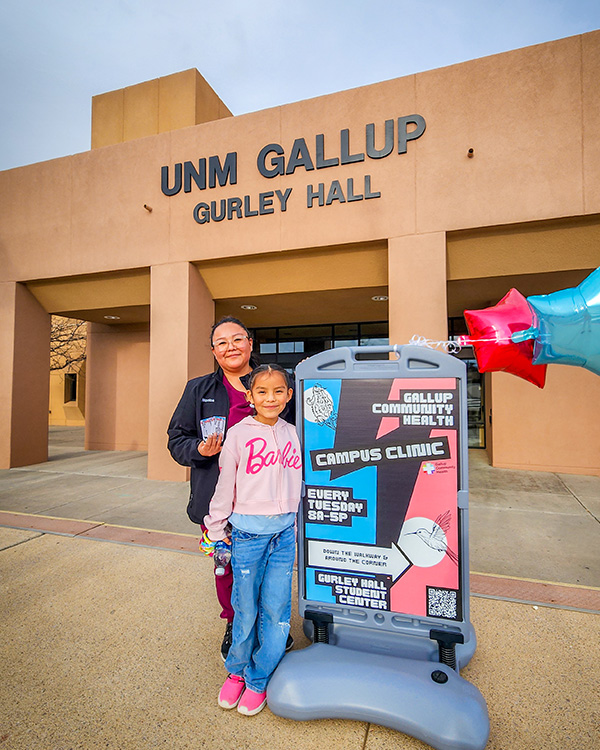
Gallup Community Health Campus Clinic opened in January with an on-staff nurse practitioner who provides a range of primary and preventive care services, including annual exams, sexually transmitted infection treatment, testing and more.
The clinic also coordinates with Gallup Community Health Center’s prenatal team to provide prenatal, postpartum and infant health care for students, their families and faculty. Nobody will be turned away due to lack of insurance or inability to pay.
A Navajo therapist on staff provides mental health services, including evaluating and treating anxiety, depression, substance misuse and other related issues.
“We’re trying to make access very easy for adolescents who we typically don’t see much of in health care,” says Pikaart, who is overseeing the clinic.